

On this day one of the most dangerous incidents of its kind occurs - at least as far as others have not (yet) become known. Although this incident was reported to the BFU, they initially did not determine it to be an "incident". An investigation wasn't even started, which only happened much later: when the incident surfaced at the German Bundestag.
The events :
Already on approach to Cologne/Bonn airport and about 20km before landing, the 35 year old captain and his 26 year old co-pilot noticed a strange smell: a mixture of a burning and electric smell. The captain thinks about putting on his oxygen mask, but rejects the thought - the "smell event" seems to be diminishing.
However, just then the co-pilot tells the captain that he is feeling "sick". He dons the mask.
At this very moment, the captain's hands and feet begin to tingle, his field of vision is restricted and his "senses are fading" – all the while the Airbus 319 continues its descent. Now panic begins to spread. The captain issues a ‚mayday’ call hoping they'll manage the landing - there are 142 passengers on the Airbus. The jet is now just overhead of the city of Cologne:
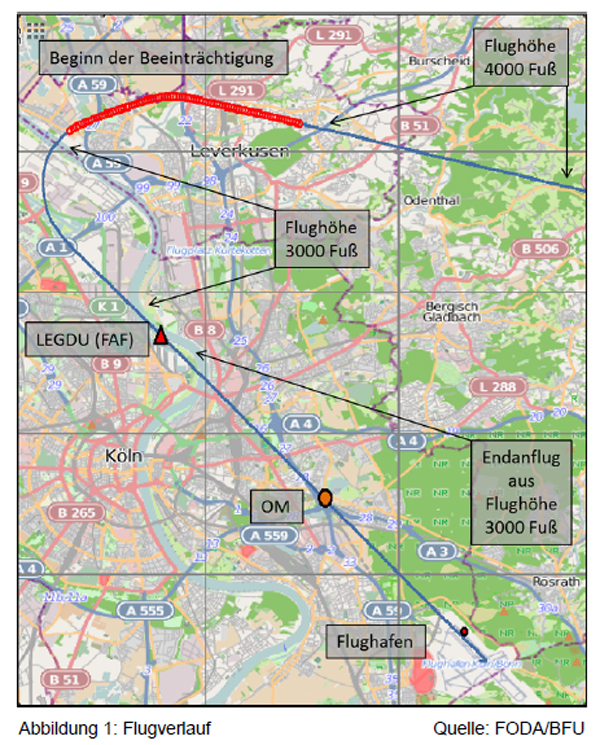
In a first reconstruction, which is only made about one year later (see below), the procedures in the cockpit read as follows:
"At this point in time, the co-pilot had difficulties to grasp the process in an overall picture. He could only concentrate with difficulty on selective aspects of what was going on and felt that he could no longer process the current information.
Also the captain had reached the end of his abilities. He felt distracted by the noise of his own breathing in the oxygen mask and found that it disturbed the communication between him and his co-pilot. During the whole approach he felt physically very ill.
On manual flight with the flight command system (flight director) he was working at the upper limit of what seemed possible to himself ".
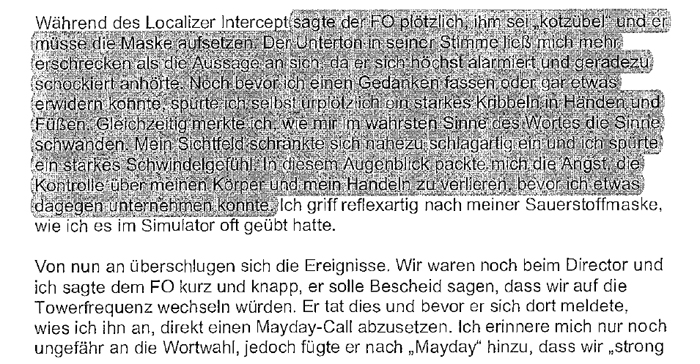
What the two pilots themselves wrote in their flight reports and how they were able to bring the Airbus down, albeit with a hard landing, as follows.
In this picture is a small excerpt. Clicking on the text opens the two complete reports as PDF:
They landed with fire brigades and ambulances already waiting on the tarmac. The captain and co-pilot have to go to hospital. The captain can fly again four days later, the co-pilot is "not fit to fly" for six months.
Only the employer's liability insurance association (BG) registers the incident as an accident - the airline reports the incident because the co-pilot is absent for half a year. Lufthansa’s subsidiary Germanwings, which has to continue paying the salaries for the first few weeks, then, wants to get money back from "BG Verkehr“.
The German BFU receives a message from the police via fax.
The further handling of this near-accident is revealing:
It will only get underway a little less than a year later when journalist and film maker Tim van BEVEREN addresses this case at a hearing in the Bundestag's ‚Tourism Committee’ in September 2011. This committee is not public. At least some members of the Bundestag are now aware that the airlines and the responsible BFU (Bundesanstalt für Flugunfalluntersuchungen) apparently do not take the mandatory reporting too seriously. At least not across the board.
Only after that the BFU begins activity. They'll produce two reports:
Aerotoxic Syndrome is also explained as a ‚nocebo effect’ in the English part of WIKIPEDIA. Albeit, in a rather different context under The presentation of the problem of contaminated cabin air in WIKIPEDIA.
The co-pilot, who was unable to fly for six months has not yet been allowed to view the medical report of the Air Force Aviation Medical Institute.
(JL)
Update::
We asked the BFU why the person concerned should not know what came out of it? Response of the Federal Office for Aircraft Accident Investigation (BFU) 26th April 2018:
"An inspection of the ... expert opinion cannot be granted due to the protection of sensitive security information to be guaranteed according to Art 14 Regulation (EU) 996/2010".